Fitting solar
What happens on install day, how panels fix to a roof without damaging it, where a battery can and cannot go, and the network paperwork (G98, G99 and export limits).
Will a battery keep my power on during a power cut?
Only if it is installed with backup equipment. Standard solar switches off in a power cut. Backup needs an islanding device such as a gateway, and…
Read the answer →02Who notifies building control about solar electrical work?
Adding a circuit for solar is notifiable electrical work in England and Wales. An installer registered with a competent person scheme…
Read the answer →03Do I need an MCS-certified installer?
For export payments under the Smart Export Guarantee, yes: the system and installer need MCS or equivalent certification, and SEG applies in Great…
Read the answer →04Do I need permission from the network operator to fit solar?
If all your inverters, including any battery, add up to 16 A per phase or less (3.68 kW single-phase), the installer connects and notifies the…
Read the answer →05Why would the network operator cap my solar export?
Where local cables already carry a lot of solar, the network operator can approve a bigger system only if export is limited, using a G100…
Read the answer →06Does adding a battery change the network application?
Usually yes. The battery's inverter counts toward the same 16 A per phase limit as your solar, so a 3.68 kW solar inverter plus a separate battery…
Read the answer →07What is a CT clamp and why does its direction matter?
A CT clamp is a sensor clipped around the incoming live cable that tells the inverter, battery, EV charger or diverter whether you are importing…
Read the answer →08What electrical protection comes with a solar system?
Expect DC isolation for the panels, an AC isolator and a dedicated circuit at the consumer unit, clear labels, and a generation meter you can read…
Read the answer →09Is there VAT or grant support for solar and batteries?
Installed solar and batteries are zero-rated for VAT until 31 March 2027 (then 5%). Grants are limited: ECO4 (to 31 Dec 2026) and Warm Homes:…
Read the answer →10How long does a solar installation take, and is scaffolding needed?
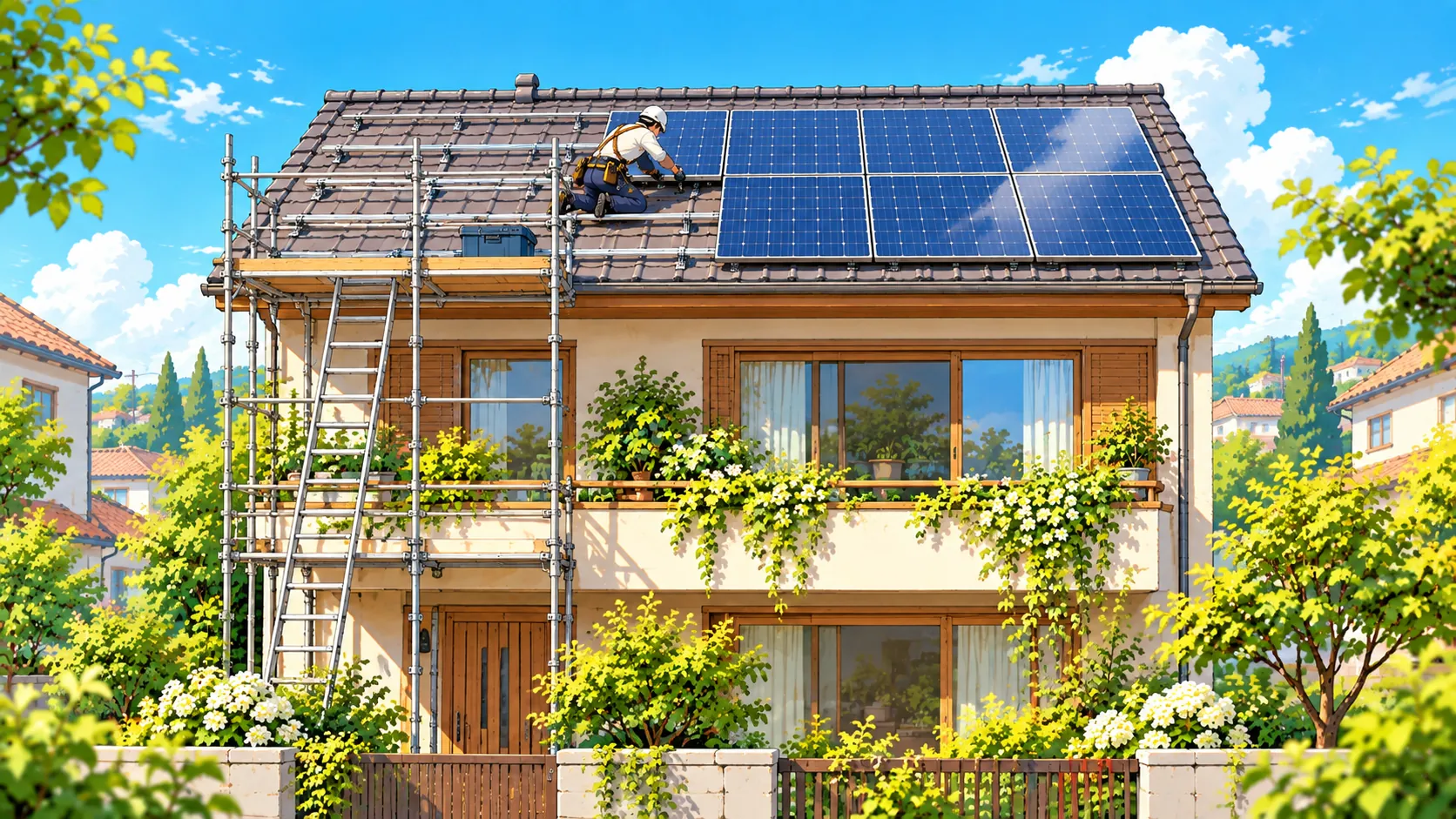
Roof installations normally use scaffolding with edge protection, usually put up a day or two before and removed after. Typical house systems take…
Read the answer →11How are panels on different roof faces wired?
Panels facing the same way are usually wired in series as one string, and each orientation goes to its own MPPT input on the inverter. Mixing…
Read the answer →12Why is my panel kWp bigger than my inverter kW?
Many designs deliberately fit more panel power (DC) than inverter power (AC). Panels rarely reach full rated output in the UK, and east-west…
Read the answer →13Should I choose in-roof or on-roof panels?
On-roof panels sit on rails above tiles and are usually cheapest on an existing roof. In-roof kits replace tiles, look flush and suit re-roofs,…
Read the answer →14Can solar panels go on a flat roof?
Yes. Frames are held by ballast or mechanical fixings. Ballasted systems need a structural engineer's check, recognised wind-load data and a…
Read the answer →15Can I put solar panels in my garden instead of on the roof?
Often, yes. Ground-mounted arrays avoid roof work and let panels face the best way, but cost more for frames and trenching an armoured cable to…
Read the answer →16Do east-west or north-facing roofs work for solar?
East and west roofs work well together, spreading output from early morning to evening, and suit a larger panel-to-inverter ratio. North-facing…
Read the answer →17Do I need planning permission for solar panels in England?
Usually not for a house. Since 27 August 2026, rooftop panels are permitted development if they protrude no more than 0.2 m and stay below the…
Read the answer →18What are the solar planning rules in Wales, Scotland and Northern Ireland?
Wales: panels up to 200 mm from the roof, not above the ridge, with extra limits in conservation areas. Scotland (since May 2024): up to 1 m…
Read the answer →19What are the rules for plug-in (balcony) solar in the UK?
Since 27 August 2026, plug-in solar is legal in Great Britain. A kit may output at most 800 W through a standard plug, have up to 2,000 W of…
Read the answer →20Can I install a plug-in solar kit myself, and where can it go?
Plug-in kits are designed for householders to fit, but the socket must be sound and suitable, with no extension leads or adaptors. Kits above 960…
Read the answer →21Why do plug-in kits with batteries need an electrician?
The plug-in law covers solar-only devices; anything designed to store imported electricity falls outside it. Balcony-style units with batteries…
Read the answer →22Will solar panels damage my roof?
Done properly, no. On tiles and slates, hooks are screwed into the rafters using an MCS 012 certified kit, tiles are trimmed or flashed so no new…
Read the answer →23Is my roof strong enough for solar panels?
Most modern trussed and simple cut roofs can take panels, but MCS requires a competent check of loads. A structural engineer is needed for hips…
Read the answer →24Should I get bird protection with solar panels?
If pigeons or gulls are common locally, mesh around the panel edges is usually worth fitting at installation while the scaffold is up. MCS…
Read the answer →25Do I need optimisers or microinverters if my roof is partly shaded?
Not always. If shade hits only a few panels for part of the day, optimisers or microinverters can reduce the loss because each panel works…
Read the answer →26How big should my solar system be?
Size is limited by roof space and budget, then judged against your annual use and when you use it. MCS quotes must show expected generation and…
Read the answer →27What does a solar installer check during a survey?
A solar survey checks which way each roof slope faces, its pitch, shading, usable area, roof covering and structure, loft access, the consumer…
Read the answer →28Can I get a solar quote from satellite images without a visit?
Yes, installers can design from aerial imagery or tools like Google's Solar API, and MCS allows remote evaluation. But the estimate must say it…
Read the answer →